Thursday, June 26, 2014

Pop goes the inner tube - final Etape/Tour de Yorkshire preparation gone wrong

All dead
 My cleats are almost worn out - making clipping into my left pedal almost impossible.

I've been riding the same set of tyres since before the Etape last year. And turboing on them too. They're covered in ominous looking cuts and worn paper-thin.

My bottom bracket is clicking under stress (when I climb or sprint).

Changing from the big to small ring frequently involves so much stress that my fingers sometimes hurt.

My chain is almost 5,000km old. As is my cassette.

And I'm riding the first two stages of the Tour de France this weekend...

On the plus side, my brake pads are in decent nick.

It was time for the final equipment check/replacement.

First things first

The cleats were pretty east to swap. I'm a bit paranoid about their positioning after my bike fit (ie I don't want to undo the good work done then), but they've been outlined in permanent marker so I checked carefully and fitted new ones.

There's an outside chance they'll need to be replaced again before the Etape proper in July, but the idea of riding more than 300km in two days struggling to clip in means if I have to replace them again, I'll gladly do it.

Tyres came next. I'm more than comfortable changing tyres and fixing punctures - and had relatively recently swapped my old tyres and tubes onto my new wheels, then added old tyres and tubes to the old wheels so they could act as spares - so this shouldn't have been a problem.

It was.

I'd bought identical tyres to the ones I used last year - Schwalbe Ultremo ZXs. They've been good servants.  The reviews say "very, very fast" ; they're light, have some puncture protection and - most importantly - I can buy ones that match my bike's colour scheme.

In the year I've been riding them I've only had one puncture - and that was a pinch after I smashed into a pot hole during a sportive, so I didn't see a reason not to buy them again.

With relative confidence I stripped my old tyre from my front wheel and tried to fit the new one. It was hard. A lot harder than I remember. I slipped and cut my hand. Then did that again.

Eventually, with the aid of three tyre levers, swearing, grunting and the like I got the new tyre on. I then inflated it whereupon it instantly exploded with an ear-splitting "BANG!".

I tried again. This time I was careful to avoid a pinch, it took seemingly forever again and was just as truculent. I part inflated the tyre and checked for a pinch again and then inflated all the way. "BANG!"

My ears were ringing a bit at this point.

Third time lucky. I was incredibly careful this time, and questioning my policy of a 120psi inflation straight away to check for pinches (although I'd rather find out in the corridor by the stairs than on the road). It held.

Worried now (I was running out of spare tubes) I gingerly approached my rear tyre. It couldn't have been simpler, tyre swapped and re-inflated and wheel back on in five minutes - without even needing levers to fit.

I went upstairs to watch Belgium-Russia. 30 minutes later "Bang!".

The front tyre had exploded again - this time it looked like a dodgy tube, it had split along the seam. Three tubes had gone on the same wheel, all bursting in different places.

This was turning into a very expensive process.

I'm now scared I've got a dodgy tyre - given how hard it was to fit compared with my memories, the rear tyre and also the last version of the same tyre. But with only a few days until my mini Tour de Yorkshire, there's not a lot I can do. The new tubes are in the post and I'm just going to have to be super careful fitting one.

Servicing and the rest

The full service (where bottom bracket, cassette, chain etc were to be checked) I had planned has also fallen by the wayside, as there are now no slots left before the weekend, and with the bike out of action thanks to tube fears I can't even do base training until the new tubes arrive.

On the plus side, the bike held up well on Saturday - getting me up the 1.5km, 9% of Ditchling Beacon pretty stress freely - so with luck it can wait until Monday when it's booked in for a full check-up.

Hopefully you can all learn from my mistakes and get everything checked out and in order now - with a month to go before the big event, not a few days.

Tuesday, June 3, 2014

The King's yardstick - How's my Etape training compares to last year

Training this year has mostly been about finding nice cafes, and buying things
This year has been far more relaxed than last in my preparations for the Etape.

By this time last year I was dieting hard and lost a good 5-6kgs, had gone on two training camps, one in Majorca one in Wales, had turboed a lot and ridden a lot more than I'd turboed.

I made a plan of progressively harder sportives to ride along the way too, and was following a training plan devised by actual sports training people to get you through the Etape.

This year, I'm 3kg over my Etape weight and haven't really dieted at all, have been on no training camps, turboed not enough and weekend riding has been sporadic lately.

The list of sportives has been replaced with social rides with a few cycling buddies - some of whom are riding the Etape themselves, some of whom aren't.

On the plus side, I lost an entire month last year (May), which I haven't this year, and have a bunch of new kit (new wheels, shoes and pedals, had a bike fit and a new Garmin meaning I can manage my performance while riding better) as well as a year's more riding in my legs overall.

I also had an excellent March's training, where I was miles ahead of where I was 12 months previously, even if I've slipped since.

But where am I compared to last year? I decided to let the King decide.


Straight after Wales last year I rode the King of the Downs, one of the hardest sportives in the UK.

You can read about the pain, and when I met some of this blog's readers in real life for the first time, etc here: http://how-im-doing-the-etape-du-tour.blogspot.co.uk/2013/06/am-i-actually-good-enough-to-ride-2013.html

I was riding it again this year - I'd prepared the day before as well as I could throwing so much pasta, rocket etc into me I felt a bit ill, headed to bed early, had a good breakfast and loaded my [new, aero] jersey with food.

I weighed in at 72.4kg ahead of carb loading, I didn't record my weight before last year's ride, but it might well be close.

But would I beat last year's time? Turns out we'll never know.

Why? Well, I may have got lost...

King of the Downs, as well as being 117 miles long, basically points you at 10 of the hardest hills in Surrey and Kent it can.

Yorks, Crocknorth, Ranmore, Coombe, Leith, Kidd's Hill [aka The Wall] and, well, Box (again, always Box).

None of them are nice, most have sections above 15% (above 20% too). Apart from Box, obviously.
The rest stop where the year before we met the readers - this year meeting no one
So what did I do? I missed a left turn sign and added an extra hill to the ride. And not any extra hill, Barhatch.

The full climb is 3km long at an average of 5%, but that average includes a brief downhill and the final section ramps to 21%.

It hurt. It hurt more because I shouldn't have to have been riding it. And because I'd smugly smiled at the people I'd seen coming up it as I whizzed down. And because, well, 21%. With gravel under the tyres making them slip.

There was another problem with this too - because if a late-ish start I had four hours to cover the first half of the course to make the cut off. I'd just added 6/7km to the course and half of that was a rather nasty climb.

I'd gone from needing to cover 90km in 4 hours to having to cover 96. So a 24kmh average needed - including break stops - having added 200+ metres of climbing to the course.

I'd also effectively lost everyone I was riding with (I was a bit ahead of them, they went by me while I was Barhatching, they would have hit the break stop first and assumed I'd not waited for them and ridden off).

I sent a text to Pez and we met at the top of Box Hill - 60km into the ride - after laughing at me, we set off to try and hit that cut off time.

The best I can say is that we were close. I averaged 23.9km/h - faster than last year, although not the full course - but with 12mins of stopping time at breaks+finding Pez I missed the cut off by 10 mins and were stopped half way.
The finish was a welcome sight - just 90km too soon
Could I learn anything from this?

Well, I'd climbed more than half last year's course (thanks to extra hill) in about half the distance at a higher average speed. But then, I also only rode 95km rather than 180+.

Comparing the first half numbers, things look more encouraging.

I was 1.6km/h faster up the first hill on the course. A tiny bit faster up the second, 0.8km/h faster up the third, a tiny bit quicker up the fourth and miles away on Box Hill (but, well, Box Hill).

So of the five climbs, I was quicker on four of them and the fifth is Box, bloody, Hill. Which I've set new PBs on this year and went up almost aggressively slowly due to my ongoing anger with being made to ride it.

Two of the hills I beat last year's time on were close, really close, with me only "winning" this year on the longest segment while the sub-segments hopped between this year and last year being quicker. But there were comfortable wins on the other two. So it's hard to say I've declined.

So, in theory, I'm a bit better than last year. Of course, it might just be the wheels...

But there's one other small advantage I have this year, the Etape is two weeks later so I've got a bit more time to train.

Tuesday, May 27, 2014

2014 Etape du Tour broom wagon / cut off times released


If you missed it, here are the official 2014 Etape du Tour cut off times (ie broom wagon times) for the ride on July 20. http://www.letapedutour.com/ET1/docs/Itin%C3%A9raire_Horaire_EDT14.pdf

The long and short of it is we have 10 hours, assuming you start in the last pen, to complete the course. At a 15kph average. Including five drinks stops, four feed stations, two cat 3s and two of the hardest mountains in the Pyrenees.

In case that sounds easy to you, last year I was struggling at below 10kph thanks to the heat and gradient on the Semnoz. And there's a lot of climbing this year.

There are four cut off points on the route at 35km in (10:34am); 67km in at the foot of the Tourmalet (12:36am); 90km in half way up the Tourmalet (14:32); and 131.5km in at the bottom of the Hautcam (16:50).

So get to the bottom of the Hautcam by 16:50 - a little over 8 hours after the final pen rolls out - and they'll let you finish by the looks of it. I'll get a proper breakdown up when I can.

Here's a dedicated page for the route of the 2014 Etape to give you a better idea of where everything is on the way: http://www.letapedutour.com/ET1/us/the-route.html

In PDF here: http://netstorage.lequipe.fr/ASO/egp/letape-du-tour/2014/parcours/EDT14_PARCOURS.pdf


Oh, and here's a mini Etape du tour 2014 route recce to see what it's like:
http://www.ledomestiquetours.co.uk/etape-du-tour-2014-the-route-and-cols/

Good luck guys!

The times in detail
Official Etape du Tour 2014 cut off times - courtesy of ASO

Wednesday, May 21, 2014

Saddle-sore, sleep deprived and celebrating: My first multi-day event


In late June I'm riding back to back Tour de France stages in, er, Yorkshire. So as a taster, this weekend I rode the two-day, 185 mile (300+km), London Revolution.

REV 2014 Map
It was meant to be a flat spin, a century ride through quiet country lanes followed by an easy 80-miler back home. But they lied.

The day one "flat route" had more than 2,000 metres of climbing. British climbing, which means shortish climbs (not normally longerthan 2km) with sections of 10-20%. And lots of them. Oh, and there was an extra 5 miles thrown in on day two too (which was another 1,600m of climbing).

Day 1 profile
Day 2 profile
But first we had to get there. Four of us were riding, last year's Team Etape members of Me, Pez and Paul, and our friend Dan. Who's new to road cycling but commutes 125 miles a week on his hybrid so is in good shape.

Or, well, should be - but managed to drink two ciders and three bottles of wine on his own the night before, woke up at 4am on the sofa, and was almost certainly still a bit drunk on the drive to the start.

Partly as a result of Dan's, er, impeded state we were really late to start. Rolling out at 9:35, when the gates officially closed at 9:30 (there was a group of about 10 of us for the late exit).

In theory this meant we'd be overtaking people all day - but we were so late, it took us 30 miles to catch anyone. At all.

Half the group we rolled out with split ahead of us after a climb - I bridged across to try and keep the mini-peleton (is there such a thing as a "break-away" that's at the back?) together, but no one came with me so I dropped back to our four (plus another of the late starters, who we lost when Pez punctured).

It's rubbish at the back even on a day like this

There's something a bit depressing at being at the very back, even on a day almost with almost perfect weather for riding. Trying to keep the group together as a mechanical would see someone thoroughly lost, riding at the slowest man’s speed while trying to complete a 100 miler before the course closed - especially as at different points we were all struggling (except, inexplicably, Dan).

There were also no groups to ride with. Anyone our speed had long gone and there were no slightly quicker groups to latch onto as they came by us.

It wasn't until the second break stop about 70 miles into the ride our isolation truly came to an end.

I responded to the long slow grind by trying to focus on my pedalling. Squeezing the top and bottom of the pedal stroke to even out power, trying to be as smooth as possible, keeping a cadence in the 80s and working my calfs as well as my hams and quads. I'm not sure it helped.

I also discovered that while feeling very pro-like in my Bodyfit kit (form-hugging, aero, de-branded Saxo-Tinkoff team wear, basically), the pad that's been wonderful on rides of up to 50 miles really isn't good enough after about four hours in the saddle.

But there was no choice now - because they had taken our luggage hostage.


Organisation

An organised multi-day ride involves a fair few changes to a normal sportive, race, long weekend ride or touring. Firstly, you start and finish in very different places. That means accommodation (in our case tents) and getting kit/luggage both to the day one finish and then back to the start where you've parked.

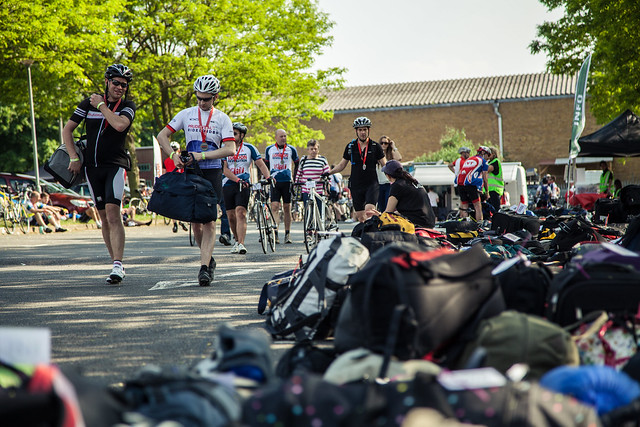
The London Revolution was pretty slick at this. Your luggage was tagged with your rider number and colour coded to find it. Tents were allocated on the same colour code and you had a wristband with this on too.

Overnight riders got a hearty meal after they were done (chicken, lasagne, bread, rice, vegetarian options, pudding etc) and there was a big cooked breakfast (if you wanted it) before you rode out the next day.

So once tagged and dropped off, your bag was waiting for you near your tent, your bike was securely parked overnight and could only be retrieved by you - but you were, nonetheless, trapped.

Pez suffered the worst. He was feeling awful, but had to make it to the end of at least day one to get his stuff back. Once he had it, he was too encumbered to get home, so rode day two to get to the end to get his stuff back again so we could drive home.

Any normal ride, you could peel off and either ride or get a train home with few problems. Or switch to a shorter route and still get back to the start (which I've done in the past while feeling bad). The format effectively took these options away.

And then there was the camping. I hadn't slept in a tent since I was at school. They'd done their best, with individual hot showers, plenty of loos, and relatively spacious tents allocated per person. But, well, tents.

Not warm, no real mattress (we had a sleeping mat, but it’s not the same), and every car, conversation, plane and animal noise reaching you as if you were in the room. Sunrise (currently 5am in London) was your alarm clock and a trip across the campsite to the loo in the dark is not for the faint hearted.

I'm still baffled that people do this voluntarily (and incredibly happy that the Tour-de-Yorkshire has us staying in a hotel).

Day 2

So after a far harder day than anticipated, we hit the hay early to try and get a good night's sleep in before an early start on day two. Breakfast started at 6:30 with the ride beginning at 7:30. We were aiming for the start of both of these.

No one slept well. We were all up at the crack of dawn anyway thanks to tents, but we'd failed to realise how many others would be too.

Starting so late on Saturday meant we weren't prepared for the number of people getting ready to leave. We didn't manage to leave until around 8:30, but riding in the middle of the pack had advantages too.

There were riders and wheels all around us all day. Carving past people, seeing people in front to catch were great motivations. I even caught the back of a couple of groups as they were passing and grabbed a wheel.


My legs (with no more treatment than a quick foam roll on my ham strings) felt strong all day, but other parts of my body were protesting at a second long day in the saddle in a row.

As the day went on my saddle soreness got worse. I found myself longing for descents, where I could take the pressure off my saddle by putting weight through my legs. I was coming out of the saddle a lot too. Now, this is one of my favourite ways to ride anyway, but I was taking it to extremes.

My left shoulder made a horrible noise when signalling to turn left after being locked in position for so long. My back wasn’t overly impressed either, but far more manageable than it had been before my bike fit.

The day started with 40km of flat, followed by two hills (one of them Box, again), rolling for a bit then a beast of a climb.

Box Hill. Again.

Starting at a few percent, the gradient ramped up to 7-8%, which was fine, then – turning a corner – it spiked into the late teens (or more). Again, fine, but it didn’t slow down again. I was in my bottom gear, standing on the pedals, with a cadence of about 50, and it didn’t slacken off. For about 750 metres the gradient just stayed somewhere between 14 and 25%. The left of the road was full of walkers, a car came the other way. I had nowhere to go but into them. I dismounted (determined to not walk on the ride), waited for the car to pass, then tried to get back on.

At the fourth attempt I managed to remount on the hill and pedal – with one foot only. I didn’t clip in first time and there wasn’t enough of a break in gradient to have time to take my left foot off and re-clip in. Another car came by with the same results. Both in forcing me off the bike and leading to huge problems re-mounting.

I gave up after the third time this happened, and walked until the gradient was a more manageably 10% or so and I could actually remount my bike. Would I have made it if the road was clear? Hard to say.

We pulled back into London 60 miles or so in, with a final break stop in Crystal Palace before 20 miles through London traffic to the end. By this point Pez was done with the whole thing. His cleat had broken on his right foot, meaning he was pedalling one legged and he was still feeling awful. He went off alone (for the second time) with a mumbled “catch me up”.

And then, after a brief tour of Peckam, Dalston, Stoke Newington and Tottenham and many, many hours in the saddle I recognised where we were.

The day before we had a long, flat, straight drag (1.6km), followed by a right turn then 300m slightly uphill to the finish. I pulled out of the group I was in and hit “time trial” mode.

Spinning up to 40kph I pushed, dropping the entire group I was riding with (who, to be fair, weren’t racing). Waiting to turn right, Paul caught up with me. So then there were two.

I’ve never had a sprint finish to a race, but as we pulled into the finish straight it was absolutely clear of traffic and other riders and I stepped on the gas. Spinning up to a maximum cadence of 137 I went through the gears, passing 40kph somewhere along the way but not looking down at any point to check. Snapping my head left and right to check where Paul was as he charged after me then, with 20m or so to go to the line and a bike length clear *. I sat up, opened my chest to display the sponsor’s logo and raised an arm in celebration (being very careful not to do this).

After two days, 190 miles, 3,800m of climbing, 6,000 calories burnt and 14 hours in the saddle I crossed the line victorious and smiled for the camera.

 Me and Paul re-united with our bags at the end


*Paul said we weren’t racing, this picture seems to suggest otherwise

Saturday, April 12, 2014

88, 140, 30.3, 0 - more data for Etape du Tour training

So in my quest to train smarter for the Etape du Tour, harder wasn't working out too well, I've invested in a better Garmin.

I don't really understand it if I'm honest. But what it does is allow me to do is get an awful lot more information both while I'm riding and to analyse afterwards.

Also, it matches my bike's colour scheme.

The numbers in the headline are my cadence, heart rate, speed and the road gradient read from the screen while I was riding today. So a pretty good cadence, a nicely controlled heart rate, a good cruising speed on a flat rode.

All of the data

It also allows better management of my gears. Better management of myself and my effort too.

My ride today took in Box Hill twice as part of a 95km "getting my mojo back" ride. The last time I rode up Box Hill I found an effort level I thought I could hold and went up in 9min 39s. Today I decided to hold my cadence at around 90, my heart rate at 180, and see what happened.

I rode my second-fastest time - 8min 27s - three seconds off my best, which was set a month before the Etape last year. A minute better than my next best time.

Now, as my previous blog post will tell you, I've not been training properly for the last week or two and hadn't exactly prepared properly the day before - drinking too much and eating and sleeping too little (although not catastrophically badly on any count).

But having the data to look at while on the bike to measure effort meant I could deliver a consistent power output without going into the red. And analyse afterwards too.

It means I can now see if there's something going right or wrong as well as get more information for comparison of segments (ie it might be slower, but now I have a heart rate comparison to see if there was a reason).

With a bit of luck, it should put me in a far better place to tackle the Pyrenees and cope while riding them in July.

Thursday, April 10, 2014

Losing my mojo when training for the Etape du Tour

So there have been a couple of setbacks in my plan for 2014 already.

First, the trip to ride Liege-Bastonge-Liege was cancelled by the operator. While this proved to be something of a relief as I was struggling to see how I could possibly manage 160 miles in a day, let alone in about 12 hours, it took out a chunk of motivation.

But things were still going well. I averaged more than 150km a week in March - out every weekend for more than 100km with a few commutes thrown in and mid-week turbos to boot.

It was going well. And then, well, I stopped.

For the last 10 days I've basically done nothing. Missed turbos, missed my weekend ride, not turned up to a sportive I'd payed for,  barely ridden to work, eaten too much, slept too little and drank far, far too much.

I need to get back onto it, I need to get my mojo back. On the plus side Pez is back from holiday now and has a ride booked in this weekend.

Hopefully getting back on the bike this weekend will help kick start my training plan. And while I lost the LBL trip, I've gained a new one.

Pez and I found a deal - we're riding the first two stages of the Tour too - the ones in Yorkshire. The London Cambridge stage is just 100 miles long and really very flat. Should be quite a good long weekend ride.

I could ride four stages this year and I've got longer than I thought to prepare. Now, if I can just get back on the bike...

Saturday, February 22, 2014

Good wheels do not make up for poor condition


Since my last sportive a couple of weeks back I've barely ridden. It turns out that I wasn't just running on empty in that ride, I was sick.

I tried to play football the next day, and only succeeded in walking about in defence trying to read the game and play like a late-career Cannavaro (unsuccessfully) rather than - well - running. Towards the end I struggled to even remain conscious. I was sent home from work early the next day for being sick.

I spent the rest of that day and the one following it asleep, only leaving bed to cram food into my face. Went to work the next day, then got sent home again. I managed a full day on Friday.

But that meant I missed last week's sportive entirely (so did Pez and Paul, both also ill). The weather mocked us all by being absolutely perfect. A couple of commutes later and  I was back on my bike this weekend, not a lot could have stopped me. You see, I had new wheels.

The incompetence of Her Majesty's Customs and Revenue meant I had a smallish windfall of a few hundred pounds - naturally I spent it on wheels.

Now I've eulogised about the impact new wheels can have, Pez had already upgraded his and I was jealous. I've been itching to buy some new ones for months.

Rebate banked I took the plunge, ordered some Fulcrum Racing Zeros from Germany (way cheaper than anywhere in the UK) and got so excited when they arrived that I didn't wait to change out of my commuting gear to rip open the box, fit tyres, tubes (light-weight latex, of course), new brake pads (Swissstop), swap the cassette from my old wheels (Shimano RS20s, since you ask) check the indexing and brake cable length, set my old wheels up with a spare cassette, tyres and tubes for winter training, then strongly considered lycra-ing up and taking the bike straight out there and then (at about 9pm).

I mean - triple milling, carbon hub, ceramic bearings, an oversize rear flange (stop giggling at the back), aero spokes, aluminium nipples (I said no giggling) with differential rim height (Stop It!)). Pros use them!*
I just stared at them for a while instead, then spun them to see how long they'd keep going (AGES!). I might have done this more than once.

Counting down the days to Saturday when I could ride them, I was eagerly anticipating 2kph added to my times, a string of new PBs and crushing Pez and Paul under my lightweight, aero, ceramic-hubbed wheels (reviewers said using them was like riding with a permanent tailwind!).

Eventually Saturday morning arrived and I rode out.

But there was a problem, I was feeling rubbish. My legs were feeling the strain early, really early. Just 30 kilometres in I was feeling like I did 80k into the last sportive. My illness and inactivity were telling and people with far worse wheels were cruising by me.

I downed a gel, it had almost no effect. 20 minutes later I reached into my back pocket for another - it was new brand to me (I had grabbed three at random in my eagerness to head out). It tasted like Soda Stream concentrate with what felt like fizz in it. Checking later I found it was well past its use by date and might well have started to ferment. This didn't help.

Another gel (not off) to get me home and I finished up 66k ridden, no PBs and no wiser as to whether the wheels made any difference at all.

In the grand scheme of things, a 3-hour ride will do me good. As will lighter, better wheels. But I need to get back on the turbo this week and step up my riding time. At the moment I'm miles behind where I need to be to even complete the medium Liege-Bastogne-Liege route come April.

*almost entirely for training, although they make an occasional appearance in the peleton

Tuesday, February 11, 2014

Too much. Too soon. A warped wheel and a puncture too - First 2014 sportive

20 miles into a sportive is a terrible time to make a decision. Unless the weather's miserable you've got no idea how you're riding that early on.

But that was the point Paul and I decided to ride the 70-mile (112km) route on Sunday rather than the 52-mile version (84km). It was a stupid, stupid decision.

Too much riding, also lumpy
To back-track a little, Sunday was the first sportive of 2014 for us. The Gatwick RideIt. The one Paul described last year as "the worst day of my life" as biting wind combined with single-digit temperatures and constant, unrelenting rain. He couldn't work his brakes by the end and took 20 minutes to warm up enough in the car to drive home (during which he got a speeding ticket). I'd phoned in sick so missed it.

This year, after a final 7am weather check, we called it. We were riding.

The first section went well. We found a group early, although it was a bit slow, so we pushed on past them. Found a second group (including one man in an Etape 2013 shirt), but they were a bit fast and lost them on a hill. We made it up a couple of solid-to-difficult climbs and hit the first food stop early and not really needing it (30km in).

It was a rubbish break stop, no loos (I needed one) - basically just a van parked on the side of a road with some food on a table outside it. We left quickly and immediately after hit the split between medium and long rides. We called long and rode on.

It was an awful decision.

I'm in no condition to ride that far. In the last six weeks the furthest I've ridden in one go is 50km (30 miles-ish), and aside from some 7.5km commutes through traffic and some time on the turbo (not longer than 1:30 in one go) - that's it.  I don't have the legs to ride 70 miles.

This was achingly apparent about 40-45 miles in, my legs were empty and Paul's weren't fizzing either. We stopped for some food.

We got back on the bikes and rode on, slower and slower as our legs flatlined. The break stop was nowhere in sight. Still, 80kms in it wasn't there (more than 50km from the last stop). I badly needed a decent break stop.

"We're going really slowly," Paul noted while I was taking lead. "Sorry!" I replied and forced my pace up. "No! It's good!" Paul shouted back. I slowed back down.

That wasn't the end of the trouble though. It wasn't raining (much) at this point, but there was standing water on the road. Paul hit a massive pothole completely hidden by a puddle (puddle doesn't do it justice, it was 20cms deep covering entire road for about 15 metres), came off in the middle of traffic and into the puddle/lake - puncturing his front tyre in the process. I was luckier, just getting drenched by passing cars and being shaken by the pothole (presumably I only hit the edge).

Fortunately, puncture notwithstanding, he and the bike were unharmed, but he was seething (and drenched). There was no way to see it. He repaired the puncture at the side of the road, got back on, and promptly slipped his chain.

Oh, and just to add to the fun, the wind was gusting well over 20mph. It was all day. Any exposed flat or descent saw us riding at about 25kmh putting in the effort to do 40. Or knocked sideways. Or both.

We somehow kept going and eventually hit the second break stop 90km into the ride - a full 60 from the last stop. My legs at this point were mostly gone - hating every incline, with even bottom gear too big to spin in in that condition.

This break stop was no better than the first, another van in a lay-by, with the dregs of the food left and a marshal who told us several other people came off in the same pot-hole as Paul. He said he thought about a caution sign, but decided against it. He seemed amused.

But, after all that - wet, tired, angry and a little scared - we decided to finish the ride. It was only 15 miles (24km) to the end.

We rolled out and the sun went away and the wind picked up again. Then the hail started. My hands and toes started to freeze. The hail stung my face. After a course marker pointed straight up when the choices were "left" and "right", we hid in a bus shelter (for the second time in two years for Paul) to find the printed map and try to work out where we should go.

We rode on.

It was at this point I heard brake rub on Paul's rear wheel. A stop to check and we confirmed it had been knocked out of true by some pot hole or other along the way. He opened his rear brakes and we kept going.

The final few kms were, to be fair, fun. Mostly flat/downhill allowing me to try a solo breakaway and time-trial to the line. I dropped the man we'd been cycling with (he looked overweight and awful at riding - knees all over the place, bad position on the bike and a pedal-stroke about as smooth as the pot-holled road -  I assumed we'd breeze by him on the flat or at the next climb. I was wrong, our exhausted condition meant he stuck with us for about 10km) and was gloriously making a dash for the stage win when Paul bridged to me.


"You've ruined my solo breakaway!" I shouted over my shoulder, he shrugged, saying he didn't realise that's what it was. Fortunately I won the sprint (uncontested).

There was, naturally, no hot food left by the time we arrived at the event centre - with only four people left on the course behind us. I forgot to get water for my recovery shake. There were functioning toilets at least.

The rain returned as we rode to the car to get home. It was the worst sportive I've ever been on - cold, windy, hail, rain, confusing course markings, badly spaced and rubbish feed stops, a course split too early, no loos, dangerous roads. Paul rated it second worst, the same event last year alone in surpassing it.

More crushing was the knowledge that if we'd swapped to the 50-miler then we'd have hit the second feed stop feeling fine (although wouldn't have avoided the hidden pot-hole), been on the road for almost two hours less and finished ahead of the hail with time for me to get home in the daylight (riding back from the station in the dark, exhausted, through London, is deeply unpleasant). The misery was largely self-inflicted.

Saturday, January 25, 2014

Spin, spin, spin your legs - cadence and Etape training

One of the more recent studies I've found shows that a cadence of 80-90 RPM has about the best efficiency rating on the flat. Most pros ride at between 70 and 90 in the hills. Froome holds 100 on climbs - bursting to 130 in sections of the last Tour. Top time triallists spin up to 120 and hold it.

I'm nowhere near that. Traditionally I've always favoured slower, with more power. It means I'm inefficient. During my bike fit my relaxed pedaling cadence was about 70 and my effort speed not a lot more than 90. The winter is a great time to work on this.

So for my first turbo session of 2014 I cranked down a few more gears than usual then tried to hold my heart rate in Zone 2 spinning my legs like a loon. My cadence was somewhere north of 90 - excellent - holding it there was a pain, but I was trying to get used to the rhythm.

The next thing I wanted to find out was the cadence I used during my commute on my single speed. Some maths later and I worked out a cadence of 90 equates to about 31.5kph.

Looking up some recent commutes, I was holding that sort of speed on the flat - which is good. But it hurt like a time trial effort - which is bad.

Hopefully a a couple of months of winter training I can get my riding cadence up as a matter of habit, extra efficiency might be all that gets me through Liege-Bastogne-Liege (a mere 93 days away....)

Saturday, January 11, 2014

Etape du Tour training starts, again

On January 6 I landed back in the UK after a trip to see family and friends over Christmas and New Year.

I got on the scales.  I was 5 kilos over my Etape weight and hadn't been on a bike of any description for weeks.

But this year the schedule is more punishing. By April 20 need to be able to ride more than 250ks and climb 5,000 metres for Liege-Bastogne-Liege and in July I'm not just riding the Etape up two of France's most famous climbs (as if that wasn't enough), I'm following the Tour around for a week, riding the climbs to get a good spot to watch the pros.

Drastic action was needed. I bought new sun glasses.

On a more serious note, training this year will be different. It has to be.

Firstly, I've had a year (well, 7 months) of cycling and training a lot more seriously than I had last year. And that means I know a lot more about myself and the bike than I did last year.

Last year I followed an online guide to get from someone who really couldn't ride a stage of the Tour De France into someone who just about could.

This year I need to push on. I know what worked best for me (mid-week turbos and long weekend rides with friends, ideally sportives) and I'm trying to kick on.

Base miles, while key, will include intervals. So will commutes to and from work (it's only a 15k round trip, but every little helps). Where last year at this stage 100k in one ride scared me, this year I need to be riding 160-200k at the weekends pretty regularly.

I've also got a bit of physio planned to try and get my body into a shape that can sit on a bike for 12 hours without falling apart.

I'll also be dieting less seriously, I knocked 10 kilos from my weight last year - this year it's only 5. So hopefully eating properly and training will do that for me without the need to calorie count.

And new equipment, of course.

Along with the sun glasses (Oakley and matching my bike's colour scheme, of course, albeit ones that were 40% off), I'm thinking of investing in some top-of-the-line bib shorts to maximise comfort.

And new wheels. My frame is already far better than the rider that sits on it, and I've got a second-level groupset (Ultegra) but the wheels are far from elite - Shimano RS20s if you care. I can knock 400g off my bike's weight, lower the rolling resistance and get better aerodynamics with a new set.

As my experience withe the Airstreeems showed, wheels really do make a difference, so now I'm waiting for a good discount to appear. And getting back on the turbo.

What are your training plans for this year and how have they altered from last year?

Monday, November 18, 2013

25 things that are trying to kill you as a cyclist in London

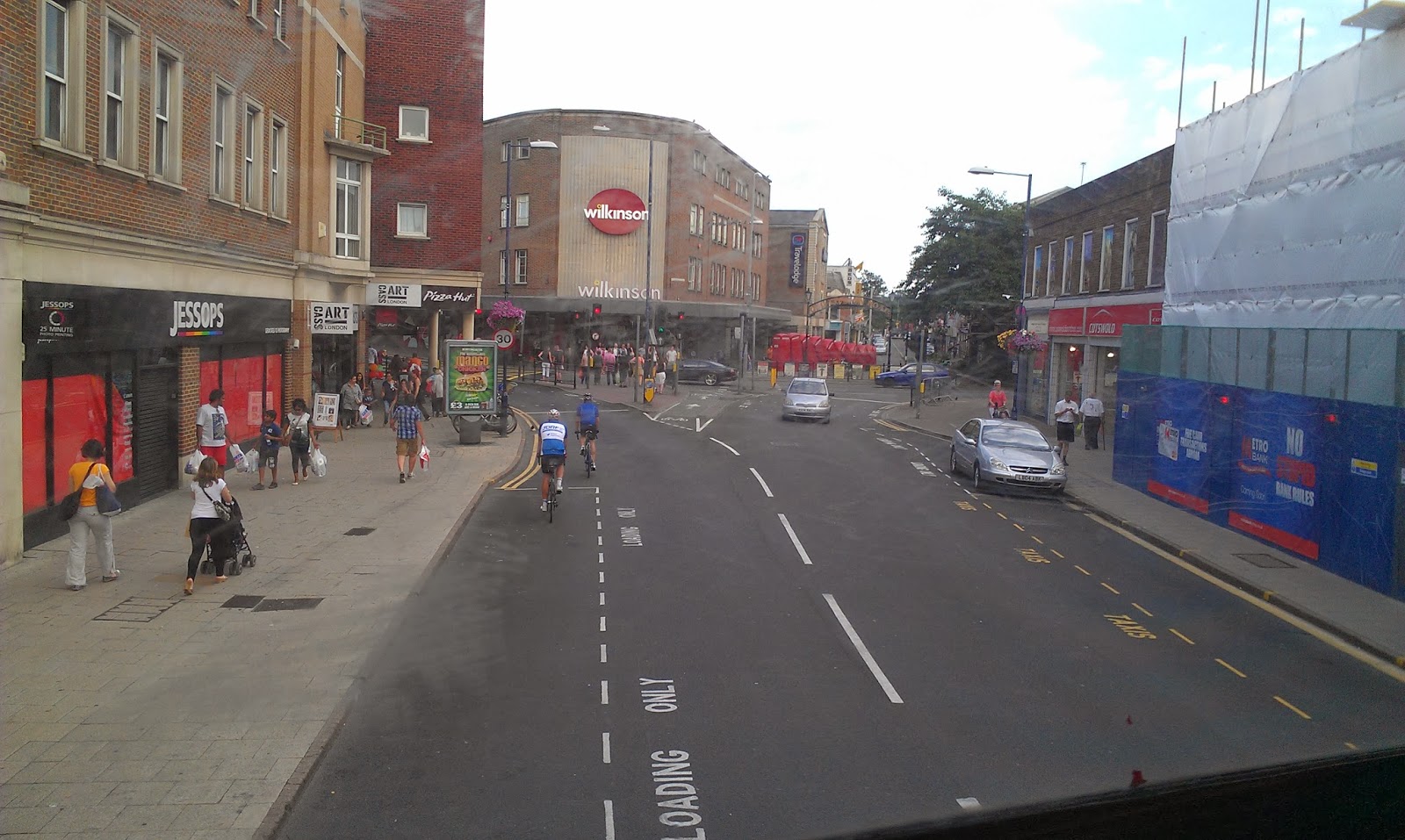
Nine separate categories of thing in the photo could be about to kill these cyclists

Here follows a list of the things that are constantly trying to kill anyone on a bike in London, in alphabetical order, because dying one way is generally as serious as dying any other. Cyclists of London, know your enemy.

Buses (moving) - large, red, slow to accelerate, easy to spot, and experienced at driving in London - buses should be fine. Two problems - first, buses and bikes share rights to bus lanes (frequently the safest place to ride - apart from the buses). Second, massive blind spots. Buses don't want to kill you, and they'll feel sad if they do, but they will kill you none the less.

Buses (stopped) - bus stops are in the middle of cycle lanes. So they pull into them, stop in them, then pull out of them. Blocking them. You're back in the traffic. Playing with the other things that want to kill you. Be especially careful passing stopped buses, whether they're signalling left or not (See above for blind spots).

Cars (moving) - cars don't always look, do turn without signalling (especially left), change lanes without looking, pass too close, pull away without signalling, shock you silly by beeping their horns because you dare to use the same road space as them, speed, stop far more rapidly than you can and a hundred other things that can see you dead. Frequently this is not their fault (when swerving or braking after a dog runs into the road, for example). Never trust them.

Cars (parked) - arguably more dangerous than Cars (moving). Cars park illegally, frequently. The one time I hit a moving car it was because a parked one had blocked my view round a corner and we both (coming in opposite directions) had moved to the middle of the road to see better (we also both slowed down because we couldn't see so no damage was done to either me, the bike or the car as a result). Parking in bike lanes or where you can't see them well in advance means pulling into the stream of traffic. And then, of course, there is "dooring". There is nothing, at all, you can do to stop yourself smashing into a door opened in front of you - apart from cycle in the middle of the road all the time - which greatly annoys other road users. Slowing down when within dooring range helps, but will not save you.

Casual cyclists – Boris Johnson has a lot to answer for. The crippling cost of public transport combined with congestion on the roads mean more and more people are taking to bikes without knowing what they’re doing, and his handy cycle-hire scheme is responsible for an awful lot of them. Boris bikers are frequently tourists, not only unused to cycling, but unfamiliar with the roads and highway code. Others are used by business men getting to and from meetings, with a sense of entitlement and belief that they are more important than every other road user and that the rules don’t apply to them. Not forgetting the drunks deciding to cycle rather than wait for a night bus or use the Tube. All of them are slow, unpredictable, in the way and to be feared. Treat them like horses, give a wide berth and expect them to do all manner of things that could result in your untimely demise.

Cycle lanes – these would be lovely if they had been build into the road design from the off. They weren’t, and as a result they mostly look like someone’s slapped some paint on a condemned house and claimed it’s fixed now. And about as effective. They start without warning, wander onto the pavement on the inside of pedestrian crossings (where, you know, pedestrians cross and wait to cross) pass roads on the left (where cars have to block them to see) throw you back into the traffic just after lights and before a bus stop then disappear – and that’s just riding the first 500m from Vauxhall to Stockwell. Don’t even get me started on CS2. In fact, I don’t need to – see for yourself. Then you get blamed for not using them by drivers. And worse, people relax in them then see them interrupted or cut off and dumped in traffic just as the most dangerous part of the riding (generally junctions) begins.  Far too many people are killed on or just after cycle lanes, if that doesn’t tell you there’s a problem, nothing will.

Drain covers - see paint, with the added risk your front wheel slips between the grating and they become de-facto pot holes too.

Green lights - people don't stop for the red ones, so don't trust the green ones. They are the smiling assassins of London cycling.

HGVs – nothing, and I mean nothing, scares me more on the roads than HGVs. They are responsible for as many cyclists’ deaths as everything else combined despite making up a tiny fraction of the traffic on the capital’s roads. In the last two weeks alone at least five people have been killed by large vehicles. Why? Massive blind spots and wheels that once you go under you’re gone. People have been hit by them turning left, at junctions as well as run down from behind (they have a blind spot in front of them as well as at the sides). Basically, if you see one take your usual level of fear, and quintuple it.

Invulnerable/oblivious commuters – no lights, or lights so powerful they blind you (and cars) utterly. Cycling in a bubble of either perceived invulnerability or utterly oblivious to what’s going on around them. They don’t stop for lights or junctions or zebra crossings or respect one way streets. One shoulder barged by me shouting “excuse me!” because I’d stopped at a red light at a cross-junction. They do often wear fluorescent clothing and have reflective trouser clips. This might be the secret to their special power to defy the law. And physics. Remember the footage of the girl who almost died trying to keep going at a level crossing – well that, all the time. They don’t plan to kill you, but the traffic accident they cause could.

Lycra louts/messengers – anyone wearing lycra on London’s streets is basically either lost, tying to prove something to themselves or has more money than sense. On a sportive, in a race, even on a long weekend ride it’s wonderful stuff – comfortable, low wind resistance, warm or cool depending on the gear and with practically placed pockets. During rush hour none of these things are relevant. You’re not in the saddle long enough to need the padding, going fast enough to care about the wind resistance and you almost certainly have a bag to stow things in with you (it's possibly, maybe acceptable at the end of a very long commute). One thing they do often have is an insane sense of entitlement, a need to prove they’re the real cyclists. They have to be at the front, they will pass you on the inside at 25mph, or on the outside as you’re trying to negotiate a bus that’s stopped in the cycle lane, or as you’re turning a corner (inside or outside). All of it can put you (both) down and under the wheels of an HGV. Take this lack of patience, replace the road bike with a fixie and the lycra with skinny jeans and you have messengers. They do all of the above but add in zipping through gaps too small for you to consider at full speed and a contempt for almost every rule of the road – especially red lights. They’ve already accepted their own deaths, don’t let them take you with them.

Motorcyclists/scooters – imagine something that exists in the same space as a cyclist but can travel at three times the speed. Well, yes, that does describe Boris bikes and everyone else, but it also applies to motorcyclists. They’re hard to see (similar size to a cyclist) and far, far faster. They also use bus lanes and ride between traffic lanes. They kill you when you think you’re safe.

Paint - I like cycling on the paint - it's smoother than most tarmac. Unless it's wet, when it may as well be ice. Going over road paint when braking or turning in the wet – even just a stripe - can see you off. Paint also wants you dead.

Pedestrians - fact* (*probably not a fact) many more cyclists have been killed by pedestrians than vice versa. Why, because they don't look, have music on, step into the road with no warning wearing dark clothing at night, trail luggage behind them and offspring and pets in front of them, are utterly unpredictable (especially the little ones), and sometimes look you in the eye then intentionally walk in front of you in some sort of crazed power trip ("Glad to see you've got good brakes" one actually said to me after doing this). They step out from behind stationary buses, vans and lorries with no warning when you are riding in a clear patch of road. As the only road users potentially more vulnerable than cyclists, you'd think they'd be more careful but, no, they're not. They are, instead, the kamikaze pilots of London's streets.

Pot-holes - you can break a wheel, somersault forward over the bars or even just lurch into traffic thanks to pot holes. Pot holes are also frequently found in places where cars brake heavily, meaning poor visibility and turnings, and on the left of the road - where cyclists tend to ride. Road users in front of you can mean you don't see them until really, really late, meaning you take the pain and the risk of damage, or swerve hard around them (which brings other potential murderers into play).

Rain - rain not only makes the road more slippery and reduces your grip, turns otherwise benign things like paint against you and soaks you - rain makes you blind. If you have glasses, they will be covered in spray and you don't have windscreen wipers. If you don't you will have to squint or risk blindness. Road spray from other road users (cyclists, be kind to your brothers and sisters and Get A Fucking Proper Mud Guard on your rear wheel - and I mean a proper one that covers half way down not just one that keeps the spray off you) gets into your face even after it stops raining and is probably worse than the rain as it includes mud and grit. Perhaps worse, it reduces visibility for everyone else, especially out of wing mirrors. Make no mistake, rain wants you dead.

Roundabouts - how do you use a roundabout safely as a cyclist? When no one else is on it or near it. If you stay on the outside lane, people will turn left into you. If you try to get on the inside lane people on the outside might not turn off. People (including cyclists) are awful at signalling at roundabouts, they also panic as they realise they're in the wrong lane and need to correct fast to make the exit they need.  There's no real accepted - or at least widely practised - way for a cyclist to deal with this. Be scared, check to your right every time you go past an exit and repeatedly to your left if you're planning to turn off. Don't trust anyone on the roundabout or roads approaching it. Far too many have died on roundabouts in the last week alone.

Taxis – everything that applies to cars applies to taxis, with the added risks that come from being allowed in bus lanes, swerving to stop to pick up pedestrians, swerving to stop to let off pedestrians and passengers opening road-side doors into your face. They have the advantage of being driven by far better and more cycling-aware drivers though** (**does not apply to Addison Lee or mini-cabs)

The cold - the cold's most obvious method of killing you is through ice on the road surface. This leads to cars skidding into you even if you avoid it yourself. But it is subtle, too. Rain and cold, or even just cold alone, can see your hands freeze up. Those hands you need for things like, well, braking. Cold has the cold heart of a serial pensioner killer, it won't hesitate to kill you too.

The kerb - like parked cars, the kerb also wants you to die. Too close to a high kerb sees your pedal "ground out" lifting the bike briefly into the air and you almost certainly onto the pavement or asphalt shortly afterwards. Clipping a kerb side on with your front wheel can also result in spilling onto the road. The problem is compounded if there are railings or signs (vertical, metal, collar-bone smashing poles) on the pavement to crash into or prevent you getting off the road.

Thieves - I heard a remarkable story of someone whose skewers were stolen while their bike was locked up. They realised coming over a sleeping policeman when their front wheel detached. I now obsessively check mine are in place before cycling off. Thieves care for neither your property nor life.

Things on the road -  pot holes are far from alone in trying to kill you - glass, nails, bits of broken car, flint - any manner of road detritus could see an explosive puncture unseat you. Plastic bags, string and newspaper can foul your gears. Leaves, when wet, will have no grip. Neither does mud. I once wiped out, on a dry day, directly in front of a bus because I hit my brakes at the exact moment a flattened beer can was under my rear wheel and it acted like a skate. Don't trust the road, or anything on it, it wants you dead.

Wind - cycling along, minding your own business, passing between two building and then - wham! Wind's got you, a two foot sideways lurch into traffic and you're gone my friend. On the plus side, it hates people with "aero" bikes and wheels far more than you. Not that you will stop it pushing you into oncoming traffic for larks.

Your bike - of course, you don't need a thief to result in a catastrophic wheel loss mid ride. Sometimes your bike has had enough with you and decides to end you all by itself. Bikes that are routinely abused or neglected (you know who you are) are more likely to suddenly fall apart than those that come from loving homes, but even the best-cared-for chain occasionally snaps, spoke pings, crank falls off, pedal breaks and cable snaps. The bike is not on your side either, watch it closely.

Yourself - let's be honest, you can avoid all of the above and still be killed on a bike. Whether it's pushing on a descent for that Strava KOM, taking in the stunning sunrise over the Thames, missing the clip on your pedals and seeing your foot scoot across them pulling away from lights, or just, well, switching off momentarily. You want you dead too - don't forget it.